AMOS TAN CHI YI 0318330
SHIFT - EJOURNAL for community service initiative
Week 0 - Project Proposal
Gary approached me with a proposal to design and built a project that invigorates his secondary school, SMK Methodist. We had a fast impromptu visit to the site, and surveyed the grounds to choose a suitable area to conduct this project. During this time, we realized that the school has an ongoing herb garden initiative, but this initiative has fallen by the wayside. Thus, we have decided to choose the existing herb garden as our site, and thus have the opportunity to integrate our proposal with the school’s students and teachers.
We also discussed the direction we will be taking for this, and decided to create an informal discussion space that is multipurpose: it is to provide interactions from all levels personal to group. We also learned that the school has serious difficiencies in certain equipment such tables in libraries, and a bus stop that is uncomfortable. These are opportunities for us to exploit and thus create a meaningful contribution to the school.
We created a plan and a roadmap for the execution of this project, and decided that while Gary will be in charge of the paperwork and financial situation, I was to be involved in the design and other subsidiary aspects.
Gary had a meeting with Dr. Veronica of Taylor’s University, and had gotten her assistance in finding potential sources of income and financing.
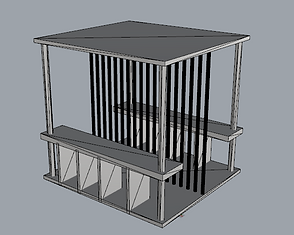
As an initial exercise, we came out with a fast sketch design:
Week 1 - Introduction Proper
With the introduction of the project, we have approached and had gotten the lecturer’s approval. We have recruited the rest of the 8-man group and have gone back to the site. We had a meeting today to discuss the execution of this project, as well as brainstorm designs. We also divided our work in order to be able to fully create a comprehensive proposal for this project. The proposal is split into a few parts, including site analysis, SWOT and introduction to the site.
It turns out, Gary had been in contact with the school authorities and word of this project had spread throughout the teachers, with positive approval.
Week 2 - Site Visit
This time, we interviewed the students and teachers about their needs and desires for such a project. More importantly, we met with the people in charge of the school to discuss the viability of the project. During this time, we conducted site analysis and did a measured drawing of the site. After the visit to the school, we toured around the immediate surroundings to reconnoitre the macro site as well as find potential metalworkers and sources of materials.
The actual site is situated within the compound of the school, and is located in the same place as the ongoing herb garden initiative. The site has a large school block to the East and a few trees to the West, and is directly adjacent to the bus stop where students frequently had to stand for hours waiting for their transports.
This site thus has excellent climatic qualities. The cool, friendly morning sun shines through the trees peering cosily into the site, while the harsh sun of the midday and afternoon are completely blocked by the mass of the school block. The openness of the site also allows winds to ventilate throughout.
The primary issue of the site would be the large presence of mosquitos and the relative obscurity of the site. The site, being situated away from offices might be vulnerable to being vandalized by the students, or used for negative activities.
Week 3 - Brainstorming ideas
This week, we looked through and analysed precedence studies of other low-cost, garden pavilions. We also have done a site analysis, which will determine the overall feel of our design. Using the data collected from Week 2's site visit, we drafted out a site plan as well as a SWOT analysis that outlines the particularities of the site.
Week 4 - Submit Proposal
We submitted the proposal to our tutor, Ms. Ann. The proposal covers the initial introduction to the site, the site's issues and location as well as how we intend to approach this project. We decided to put forth the early sketch design done even before the semester started as the design was not finalized yet. Anna had done a few precedence studies on such similar projects, and it gave us a clear idea and direction as to this programme's potential execution.
Week 5 - Explore Cubes
To ease our design, we decided to create a framework from which we can easily create and improve on ideas. Rapid prototyping, as such. Here’s a few:
By creating a unifying element (the steel SHS frame), we can rapidly produce a dizzying variety of interesting forms and programmes. We had the idea that this could then become merge together to form a cohesive but yet enjoy variety in function, aesthetics and circulation.
Later on the same week, we revisited the the idea and redesigned it to have a more cohesive and structured approach. Thus, the core of this new design is composed of the Study Pod. The Study Pod was to be modifiable and kinetic, allowing the students to move a partition to create spaces depending on the size of the party. This Study Pod also has provisions for planter boxes in an attempt to integrate the herb garden initiative. We also found that the Lemongrass plant aids mightily in combating the mosquito problem, with the scents that it creates a shield against the insect.
We have decided that in order for the school to have true ownership of the site, that we should have the students involved in the design and fabrication of the project. Thus, we have envisioned several mini pods that are designed by the students to enhance the project and inject a bit of the school’s identity into this endeavour.
Two of our members went back to SMK Methodist this week, and have announced the project to the students. They met with teacher in charge of this project, and was notified that the school is now searching for committed members to join this project, and they will aid in the construction and design.
Week 6 - Finalize Design
Following our tutor’s comments, we have further developed our design to better counter the problem of vandalism as well as further integrate the herb garden into the design. To this end, we developed a new design.
This new design is composed of two components: a heavily modified Study Pod, and a new Vertical Garden. The Study Pod has lost its movable partition (for fear of it being jammed and needed repairs) and is now a lot easier and cheaper to build. It has not lost its architectural qualities, however, and the new permeable walls and roofs still afford it discretion.
The Vertical Garden serves as a separator between spaces, and is standalone. This Vertical Garden provides a degree of privacy as it psychically shields the Study Pods and its spaces between, but still is permeable to the elements.
These two components together compose Shift, a multipurpose pavilion that seamlessly integrates the existing herb garden initiative into providing a place for students to meet in groups or alone.
Week 7 - Poster Submission
With this new design, we submitted the A0 poster. This poster is shown below:
Click to enlarge.
Week 8 - Site Visit 2: Satisfaction Survey
The second site visit was held during SMK Methodist's Teacher's Day celebration. During this time, we met with the headmaster of the school, Mr. Woon to finalize the design, site and financial properties. At the same time, we met for the first time the team of 21 students from SMK Methodist who will be participating in this programme.
We had a short time of introductions before we explained to them our design, and asked for their feedback. The majority of the feedback was positive, and they were very excited to be able to contribute to the beautification and revitalization of their school. This attitude was highly promising, and they were eager to help. Some disagreed on the choice of colour, however, and wished to see it in a darker colour to combat vandalism.
The same could be said when we showed this very design to the teachers present in the school. They agreed on the choice of site and the programme of Shift, and were very happy to see yet another potential benefit for the students. They could see that the impact of this project would be largely positive, and that students will be able to use Shift for discussions, rest or even just socialize.
All in all, all parties involved are highly satisfied with this design proposal, and now actions are being taken to move this project into realization. During this time, we recorded on video their reactions, which would then go on to be featured in the final CSI video.
Week 9 - Model, Construction Drawings & Price Quotation
After receiving the go ahead from the school authorities, we have now commenced on the creation of the needed paperwork to make this dream a reality. Philia and I created a 1:20 model for the CSI Video and also as a vehicle to better explain to the students our design, while the rest of the team were tasked with the production of the needed construction drawings.
We reconnoitered suppliers of metal and other materials to obtain pricing quotations. This is required to ascertain and estimate total cost of the project, while also seeing in person the quality, strength and suitability of such materials.
Week 10 - Video Submission
Finally, the video was submitted this week, while work is still going on on obtaining materials and their respective prices as well as the production of construction drawings.
This ends the Community Service Initiative Module, but not for Shift. As the end goal of this project is the erection and construction of the actual design, work is still being carried out to ensure this proposal ends up a realized dream.
Future - Construction
We hope that Shift will be able to be fully completed and operational before the end of August. Efforts are currently being made to procure materials, create drawings and others.